
Fluctuations From The Vacuum
The principle of energy conservation states that nothing is created and nothing is destroyed: every form can transform, but the total remains unchanged. In the physical vacuum, this balance reveals minute energy fluctuations, imperceptible and fleeting, which emerge and vanish like waves on a still sea. They oscillate around a null average value, showing that space, though apparently empty, is in fact a living stage in constant motion. Even the smallest particles could, in principle, interact with this primordial fabric, igniting the spark of a universe. The vacuum, therefore, is never complete absence, but a dynamic field awaiting manifestation.
This is demonstrated by the Casimir effect: by placing two conducting plates at a nanoscopic distance, with no electromagnetic energy between them, an attractive force is observed. This phenomenon arises from the difference in minimal energy density between the space enclosed by the plates and the surrounding exterior. The experiment, simple in conception yet surprising in its results, reveals that apparently empty space contains residual energy—a whisper of the vacuum that becomes detectable only under extreme conditions. The oscillations between the plates suggest how even what appears inactive may conceal latent motion.

Positive And Negative Energy
Matter itself is concentrated energy, capable of releasing immense quantities when transformed, as in nuclear processes. This gives matter energy a positive sign, making it the protagonist of the visible manifestations of the cosmos. Even when contained in infinitesimal particles, it fuels stars, galaxies, and complex structures, imprinting dynamism on a nascent universe. Matter energy expands, transforms, and interacts with its surroundings, constituting the fabric upon which the earliest cosmic evolutions unfold. In this way, every minimal quantity of matter possesses enormous potential, invisible yet decisive in the cosmic dance.
By contrast, gravity can be seen as negative energy: an attraction acting upon matter and energy. In the primordial vacuum, energy fluctuations appear to return spontaneously to a state of balance, without current physics being able to indicate a precise cause. The universe thus maintains a fundamental symmetry between positive and negative energy, even amid the dynamic manifestations of fluctuations. This invisible balancing allows vacuum oscillations to unfold within coherent limits, providing stability to the cosmic stage on which the first material structures develop. The perfection of this balance is, at present, an unresolved enigma.
The Trigger Of The Observable Universe
At an epoch estimated at 13.8 billion years ago, a vacuum fluctuation triggered a rapid expansion of space and of the energy contained within it. This event, still mysterious, broke the initial symmetry and ignited the transformation of the vacuum into an evolving universe. From the first oscillations gradually emerged material structures, including fundamental elements such as carbon, at the basis of living matter. The primordial trigger established the conditions for global energy balance and laid the foundations of the observable cosmos. Without this brief, sudden jolt, the universe could never have developed with such richness of complexity.
The balance of the primordial event projects itself onto ever larger scales, maintaining a precise relationship between opposing energies. The positive total of matter and the negative total of gravity—enormous yet finite values—continue to compensate each other, so that the universe maintains an overall zero energy. This concept defines a theoretical model of the universe in which the dynamics of primordial fluctuations give rise to stars, galaxies, and complex structures without violating the principle of energy conservation. The complete harmony between positive and negative sign thus appears as an extraordinarily refined and coherent natural condition.
From Models To Observations
According to the most robust hypotheses, then, the universe originates from the vacuum, transformed through an initial event. The zero–total-energy universe model posits that the birth of space, time, and matter derives from a primordial quantum fluctuation, while respecting the same physical laws that govern its evolution. This framework offers a coherent way to interpret cosmological observations, linking the microcosm of fluctuations to the macrocosm of visible structures. In this way, even the smallest quantum event finds reflection in the overall architecture of the universe, in a bond between the microscopic and the immense.
Physicists study the origins of the cosmos by observing the smallest particles. Through ultra–high-energy accelerators, they attempt to recreate conditions close to the universe’s earliest instants. By accelerating particles to extreme levels, they exploit the convertibility between matter and energy and gather clues about the behavior of vacuum fluctuations. Although it is impossible to reach the conditions of the infant universe, these experiments reveal the fundamental mechanisms that regulated primordial expansion and the formation of the first atomic nuclei, offering a bridge between theory and concrete observation.
Light In The Earliest Moments
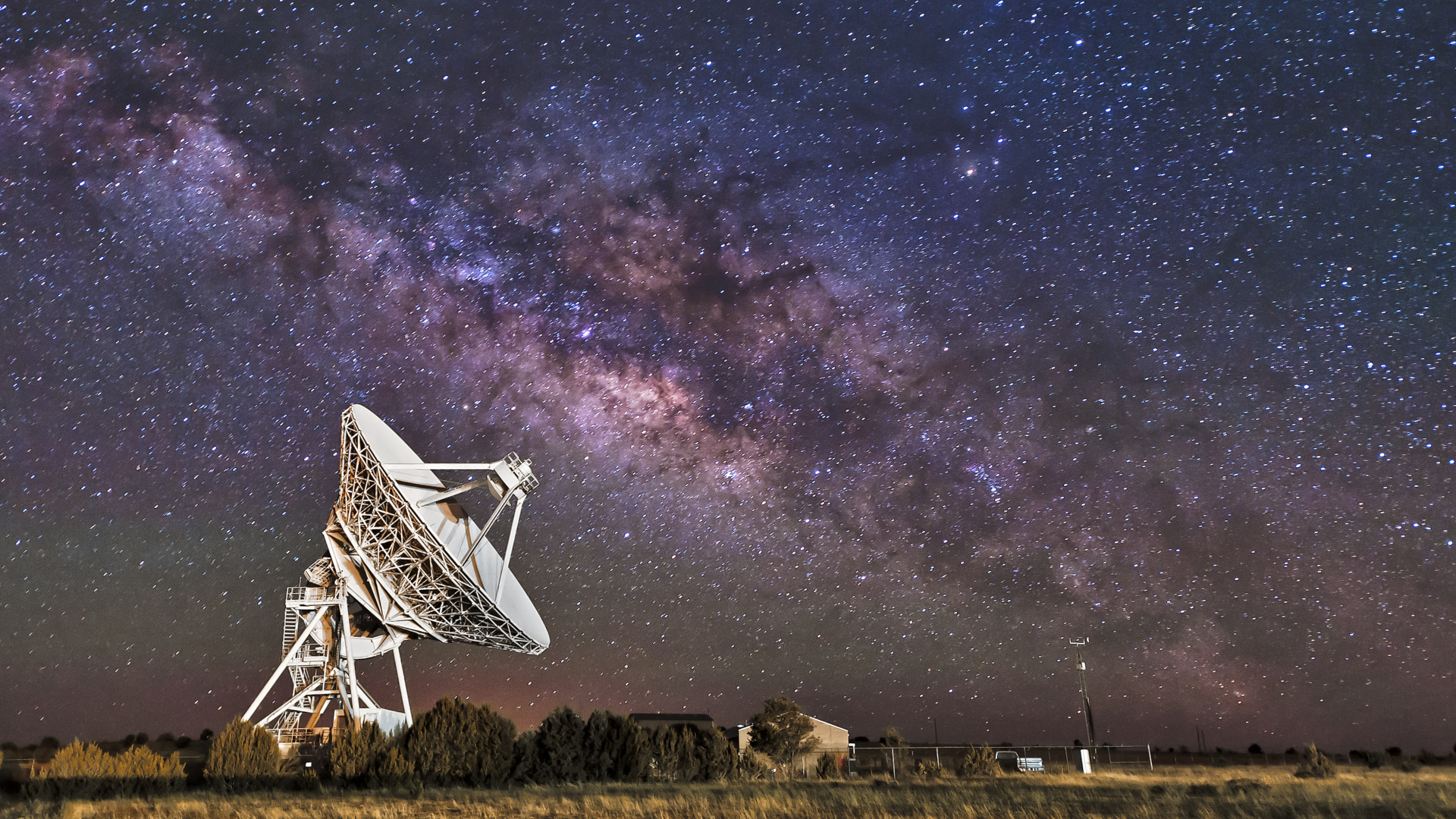
At the other extreme, cosmic observations study light and radiation that have traveled for billions of years. Radio telescopes detect signals of the cosmic microwave background, the first visible snapshot of the universe’s evolution. This light bears witness to the separation of luminous energy from the primordial complex and allows the reconstruction of phases following the great expansion. Though limited by the finite speed of light and by observational constraints, the data offer an overarching view of energy and matter on gigantic scales, and the ancient universe thus becomes an increasingly open and legible book through light.
Beyond matter and radiation, the cosmos is governed by fundamental forces that determine the cohesion of physical structures. Strong nuclear, weak nuclear, and gravitational interactions act with different intensities and modes, ensuring order and stability in the universe. While not directly defining matter, these interactions allow the formation of celestial bodies and the coherent distribution of energy, enabling the complex cosmic dynamics observable today. Together, they create the invisible architecture upon which physical reality rests, weaving links between fundamental elements and macroscopic systems.
Primordial Unity And The Birth Of Spacetime
It is believed that in the initial phases all interactions were unified into a single primordial force. Governing the original vacuum, this force regulated matter, energy, and gravity in perfect symmetry. The subsequent separation of components then allowed observable complexity, but the common foundation remains the origin from a single physical principle. This initial unity suggests that the order and coherence of the cosmos derive from that primordial condition, and that only later do the differences among today’s known forces develop. Even the smallest observable detail in the present bears the mark of that original unity.
Spacetime thus emerges as the outcome of a transformation of the original vacuum, a point at which order takes form from disorder, as if chaos itself had found within it the necessity to exist. The analogy with ancient narratives is not a theological comparison, but a distant echo, nevertheless grounded in the same urgency to give a beginning to that which has no beginning. For in the vacuum that ignites with energy and form, matter and light become the primordial language of being.
The opening statement, which belongs to theoretical physicist Lawrence Krauss, suggests that what we perceive as existence is merely an unstable configuration of the quantum vacuum. In this view—where “vacuum” does not coincide with “nothingness” but represents the limiting condition in which every equilibrium is destined to transform—the universe with zero total energy does not derive from an external or transcendent principle, but from an intrinsic necessity: the tendency of the vacuum itself to generate reality as form, time, and matter.