
The Beginning and the Mystery
“First of all was Chaos, and then broad-breasted Gaia, the everlasting and secure seat of all the immortals.” From this simple and absolute declaration begins a vision that does not merely narrate the world’s origin, but attempts to express its unfathomable depth. Every cosmogony, in its symbolic language, reflects the human need to think what precedes every thought—what is not yet, and yet makes every being possible. In the name of Chaos, the ancient mind projects the attempt to say the unsayable: the threshold of the beginning, where every word becomes an echo of primordial silence.
Unable to give rational, complete, and finite meaning to eternity—which is instead an infinite series of successive states of reality—human thought feels the need for a beginning. Time, in order to be thinkable, must have a first breath, an instant that inaugurates the rhythm of being. And so myth becomes the form through which the mind builds an image of the eternal, translating it into story. In that primordial narrative lies a cognitive gesture: imagination supplies what reason cannot yet measure.

The Necessity of a Beginning
But then, before the beginning, there should have been a moment when the world “was not,” in an empty time, when nothing could begin—neither by itself nor from another cause. And beyond the limit, a place where the world “is not,” a space without direction or meaning. The human mind, unable to accept an absolute void, projects images and hypotheses onto it, giving form to what it cannot know. Thought, like the universe, thus seems to oscillate between the necessity of a beginning and the vertigo of eternity.
This antinomy of the world—between a thesis of a beginning and an antithesis of eternity, both credible and consistent suppositions, though irreducibly opposed—set out by Immanuel Kant in 1781 becomes a philosophical threshold. In it, the limit of reason and the infinite power of human questioning can be measured. Hesiod, narrating the rising of the gods from Chaos, unknowingly takes the first step in that same tension that will run through centuries of thought: the search for an intelligible order in being. From this threshold will arise, much later, the idea of a knowable principle, the arché of the first philosophers.
The Limit and the Vertigo
The Theogony is, for example, a mythic legacy of imposing crescendo, which from the birth of the universe’s primordial elements arrives at the establishment of Zeus’s reign. About twenty-four centuries before Kant, Hesiod, a farmer from Ascra in Boeotia, tending his flocks on the slopes of Helicon, finds himself raised up as a singer of truth. The divine voice of the Muses transforms him into an instrument of revelation, and through him the word becomes the means by which chaos takes form, the substance of the universe is ordered, and the unknown assumes name and face.
Through mythic time and the sacred lineage of the gods—from the Heliconian Muses, inspirers of eloquence and harmony of speech, to the foundational couple formed by Gaia, the earth, and Uranus, the sky that covers and fertilizes it—the Theogony builds the web of cosmic relations. Every divine birth is a form of knowledge, a passage from the formless to the named. Within this poetic genealogy lies a symbolic cosmology, where the word orders, distinguishes, separates, and at the same time unites: language becomes a principle of world.
The Word That Orders The Cosmos
To the original pair of Gaia and Uranus is owed the generation of the forces that sustain the cosmos. Every essence is born from another and carries with it the mark of an inheritance. Hesiod’s universe is not a mechanism, but a genealogy of powers: light, night, discord, love. Everything that exists participates in the same vital substance that moves and transforms. In this chain of descents, good and evil, order and violence reveal themselves as inseparable aspects of a single reality in becoming—never still, never concluded.
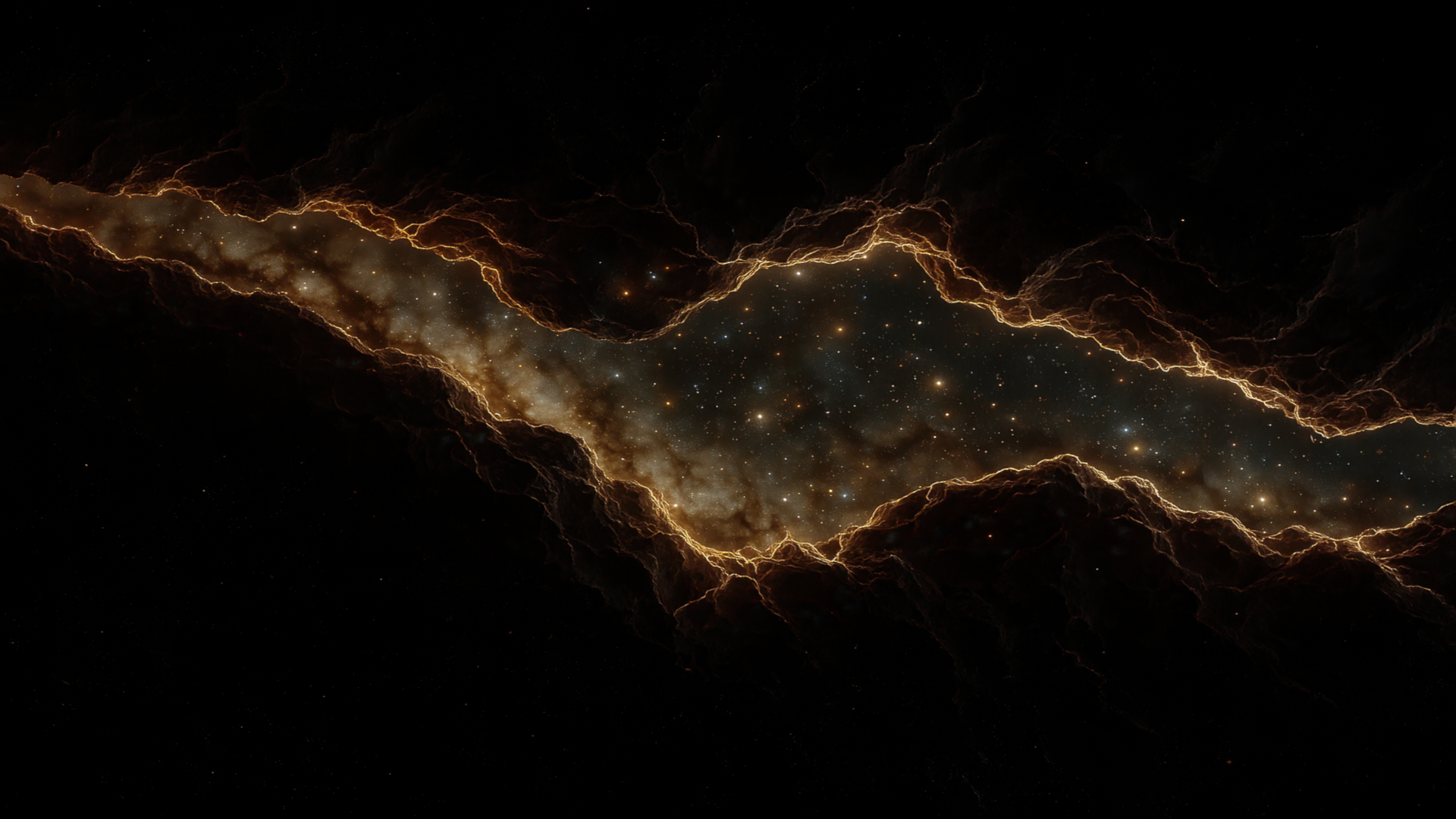
All of this, however, is born after the advent of Chaos, the first divinity and the founding notion of the mythic work. Chaos too is a god, though barely described, as if to underline the mystery of genesis. It is the abyss that precedes form, the womb of the indeterminate. Chaos generates without joining, produces without measure, and from it emerge Erebus, night, sleep, and discord. Its darkness is not mere absence, but possibility. It is the place where everything can still be, where the world, before becoming order, is still suspended between potency and negation.
The Abyss That Generates
But, physically, it is also a gaping chasm, an opening that marks the boundary between what is and what is not. The term that designates it indicates a space that opens up, a passage more than a disorder. Only in later ages would “chaos” take on the sense of formless matter or absolute disorder. In Hesiod, by contrast, it is an act of origin, a principle that appears as a primordial fissure. It is in that fissure that time begins to flow and space takes direction: not the chaos of entropy, but the threshold of becoming.
From that void detach the other primordial essences: Earth itself, Gaia; deep and stormy Tartarus; and primordial Eros, a principle of union and desire. In them intertwine the forces that move the world and life. Tartarus holds depth, Eros the creative impulse. Thus myth, even without knowing a natural explanation of phenomena, recognizes the entanglement of destruction and generation. Every birth implies a risk, every balance a conflict. In this tension, Hesiod glimpses the very breath of the universe.
From The Voice Of Myth To Thought
Although the work must be understood within a civilization that still does not seek in rational and natural causes an explanation of universal phenomena, in that Kantian antinomy between a thesis of a beginning and an antithesis of eternity the cosmological conception that emerges from the Theogony would refute the second. The world, in Hesiod, is not eternal but generated. And yet its origin does not lie in a creative will, but in an immanent force that “comes to be.” Thales will seek in a visible principle the measure of the invisible, introducing the question of a knowable and unified order that will guide later thought.
Thus, from Hesiod’s Chaos to the thought of the first philosophers, the human being crosses the threshold between myth and reason. Ancient cosmological poetry slowly becomes philosophical question, and the need to tell the world becomes the need to understand it. What in Hesiod’s verses was song and image becomes in Thales interrogation and inquiry. The same tension that animated poetic speech now becomes investigation: an invisible thread joins the void that “was in the beginning” to the water that “generates everything,” like two faces of a single thirst for knowledge.
Myth carries thought to the limits of the human, where origin and eternity intertwine without a definitive resolution. Hesiod’s cosmic images recall that to understand the world is to accept tension and mystery, and that the search for a principle has always been part of human history. The poetic inquiry into Chaos and the gods also lays the groundwork for later thought, preparing the terrain for rational philosophy and for the discovery of principles that, though invisible, govern the order of reality and the harmony of life.